

















































UK shoppers are becoming pickier about jewellery. Meanwhile, brands here know that strong sales now depend on pieces that look premium and remain that way after real and everyday wear. That’s because nothing hurts reputation faster than faded plating or tarnished surfaces on new collections of gold-plated brass jewellery. So, plating thickness is now a key detail behind the scenes. Quietly, it decides how long that rich colour lasts, how solid the finish feels in the hand, and whether your product still looks “launch fresh” after months with the customer.
What is Gold-Plated Brass Jewellery?
Gold-plated brass jewellery simply means a brass core, which is a copper-based alloy, and covered with a thin outer layer of gold to give the look and feel of solid precious metal at a more workable cost. Brands can play with other plated finishes, too, such as soft rose gold, subtle champagne gold, or crisp white gold. Along these lines, their collections can match different UK style preferences. Still, they are being produced on the same underlying brass base.
Why Gold-Plating Thickness Matters
Durability
When the gold layer is thicker, the surface stands up better to friction from stacking, storage, and daily handling. Thus, pieces are less likely to show base metal through high-contact areas (edges and clasps). This is why brands that position themselves as premium specify tighter plating standards for their gold-plated brass jewellery to decrease visible wear issues after launch.
Longevity
Similarly, good thickness slows down how quickly the finish changes over time. It implies that the colour remains steady during periodic maintenance, seasonal dips, and longer marketing cycles. What is more, it provides you with greater confidence that returning buyers will see older pieces on actual people and still interpret them as current and well-kept.
Aesthetics
A slightly thicker layer looks more even and saturated. It helps your designs photograph better for e-commerce and social media. Plus, it supports a more consistent colour tone across different batches. Your lookbooks and restocks feel coherent rather than “almost but not quite” matching.
Value and Cost
Plating thickness is also a cost lever. The reason is that adding more gold increases material spend, but when it is planned appropriately at the OEM stage, it might lift perceived value, decrease returns and complaints, and justify higher price points. Consequently, it makes the margin picture healthier for a collection built around gold-plated brass jewellery.
Common Plating Thickness (micron)
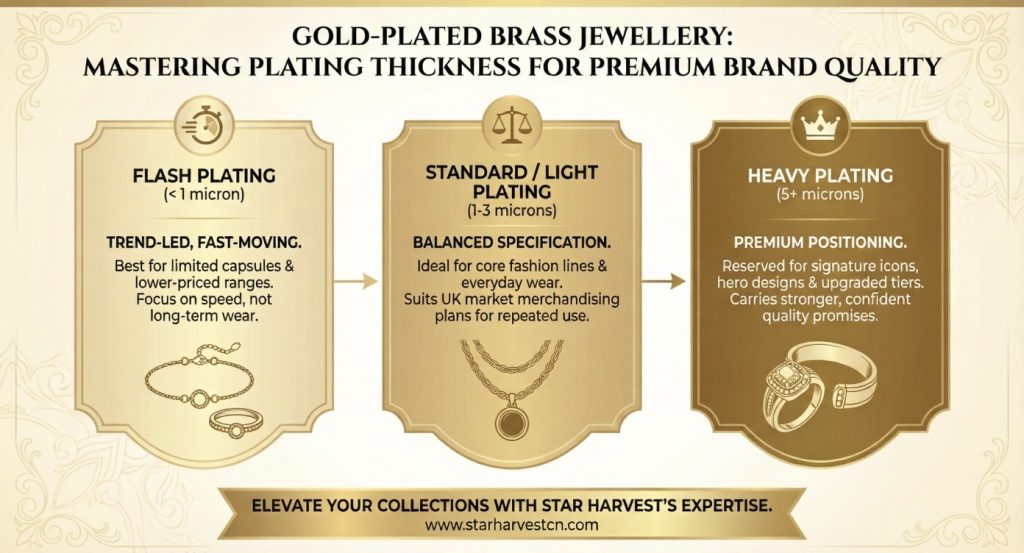
Flash Plating (< 1 micron)
Flash plating uses a very thin gold layer, which might be under one micron. Mainly, it is chosen for fast, trend-led pieces when the collection will move quickly. So, it suits lower-priced ranges or limited capsules rather than long-running evergreen styles in gold-plated brass jewellery.
Standard / Light Plating (1-3 microns)
In the 1-3 micron range, brands get a more balanced specification that works adequately for core fashion lines. That’s where pieces are worn repeatedly but still need to remain within tight merchandising plans. Thus, this level is used for everyday collections in the UK market.
Heavy Plating (5+ microns)
At 5 microns and above, the plating is positioned for premium lines. It is linked to hero designs or signature icons and might be reserved for SKUs. That’s when the brand wants a clearly upgraded tier that can carry stronger positioning and more confident promises to customers.
Factors Influencing Gold Plating Quality
Base Material Quality
Quality starts with the brass itself. A clean, well-polished, and prepared surface lets the gold bond more evenly. Hence, brands that want consistent gold-plated brass jewellery specify tighter controls on alloy composition, hardness, and pre-finishing before any plating tank is involved.
Plating Process Control
In production, everything, including but not limited to bath chemistry, filtration, temperature, current, and time, in the tank has to be monitored closely. The reason is that even small shifts can cause patchy colour, rough texture, or weak adhesion. Meanwhile, this is why serious OEM partners log and track each step rather than treating plating as a single simple dip.
Post-Treatment and Care
After plating, protective topcoats, anti-tarnish steps, and controlled drying help stabilise the finish. Clear brand-side care guidance on storage, moisture, and cleaning gives the plated surface a better chance to remain looking fresh across its complete selling and wearing cycle.
Working with Star Harvest for Guaranteed Plating Standards
To translate these technical plating advantages into real market success, you need a partner who can seamlessly integrate precise plating control with your brand’s quality promise. Star Harvest is an OEM jewellery manufacturer that has concentrated on brass and stainless steel pieces since 2005. So, they know how to support growing brands with steady production and on-time delivery. They can set gold layer thickness to your exact specification across different tiers in a range, and you keep control of quality and margin. Colour options entail yellow, rose, champagne, platinum, gun black, and more. Thus, your 18k gold-plated brass jewellery can share one design language and still hit different style moods. Their jewellery electroplating setup combines vacuum and water plating, nano-level control, thickness gauges, and salt-spray testing. It implies tougher finishes, fewer complaints, and smoother UK or EU launches.
Contact Star Harvest today to discuss your next collection and ensure your gold-plated jewellery meets the highest standards for quality and longevity.