















































 There’s a particular kind of frustration that comes with furnishing a living room. You find a sofa you love – the shape is right, the fabric is perfect – and then you measure your space and realise it doesn’t fit. Or it fits, but only if you accept that the traffic flow through the room will be awkward forever. Or it fits and the flow is fine, but the configuration is fixed, and six months later you’ve rearranged everything else and the sofa no longer makes sense where it is.
Standard furniture wasn’t designed around how people actually live. It was designed around what’s efficient to manufacture and ship. Modular sectionals exist because someone eventually asked the more interesting question: what if the furniture adapted to the space instead of the other way around?
The case for going modular
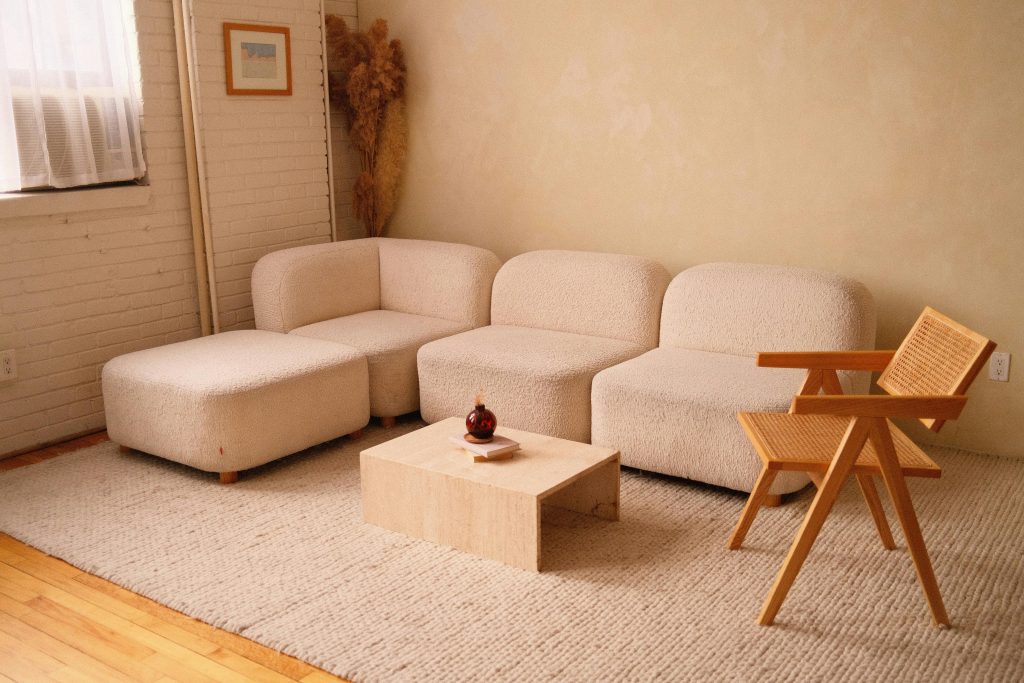
A modular sectional is built from individual pieces – a corner unit, armless seats, a chaise, perhaps a storage ottoman – that connect together. The distinction matters because it means the configuration isn’t fixed at the point of purchase. You can build an L-shape for a compact flat, a U-shape for a larger open-plan space, or something more asymmetric depending on how a room actually works. And if you move, or redecorate, the sofa moves with you rather than becoming a problem to solve.
For anyone who rents, or who treats their living space as something that evolves rather than something that gets settled once and left alone, this flexibility is genuinely useful rather than just a marketing point.
Design considerations that actually matter
The mistake most people make when choosing a sectional is leading with aesthetics and treating everything else as secondary. Colour and fabric should absolutely be part of the decision – they’re the things you’ll look at every day – but the configuration logic comes first.
Start with the room’s architecture. Where are the doorways? What’s the natural path through the space? A sectional placed against a wall reads very differently from one floating in the middle of a room, and not every configuration suits both situations. Think about how many people regularly use the space, and what for – a household that hosts often has different needs from one that uses the living room primarily for winding down alone.
Seat depth is another variable that goes under-considered. A deep seat encourages lounging and feels generous in a large space; in a smaller room, or for someone who prefers to sit upright, it can feel like the sofa is consuming the room. Some modular systems let you dial this in per module, which is worth knowing before you commit.
If you’re new to configuring modular furniture, DreamSofa’s step-by-step planning guide is a solid starting point – it walks through the key decisions in a logical order and helps you think through sizing and configuration before you’ve committed to anything.
Fabric as a design statement
Velvet remains the statement choice, particularly in deeper tones: forest green, dusty rose, a rich slate blue. It photographs beautifully and transforms a room in a way that a neutral linen simply doesn’t. The trade-off is that it requires more care and shows wear more visibly over time – something to factor in honestly depending on your lifestyle.
Performance fabrics have improved considerably and are worth reconsidering if you’ve written them off as functional but boring. The newer weaves hold up to daily use without reading as purely utilitarian, which makes them a reasonable choice for anyone who’d rather not think too carefully about what they’re sitting in.
Bouclé has had a sustained moment in interior design, and for good reason – the texture adds dimension without the formality of velvet, and it works across both contemporary and mid-century-adjacent spaces.
The longer view
Furniture is one of the few categories where you should consider the long, long-term (decades rather than years).
A well-made modular sofa should last a lot longer than a cheaply produced alternative, and because they can be reconfigured whenever you like, it makes sense to think long term about what you really want.