










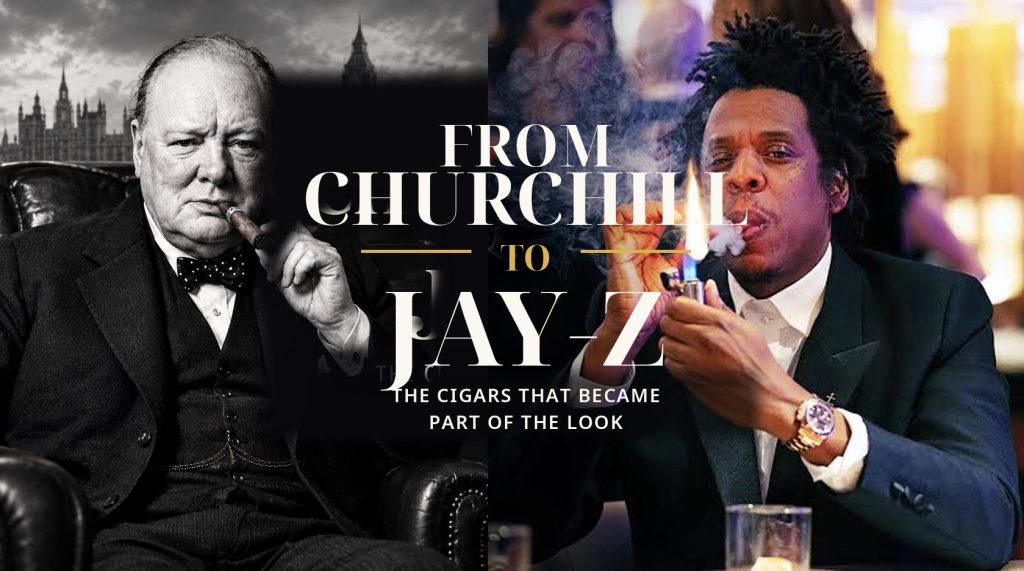
A good watch tells you something about the person wearing it. So does a well-cut jacket. Certain cigars have done the same job, becoming so closely tied to their smokers that they are now part of the public portrait, as recognisable as a profile or a silhouette.
Here are five of those stories, from a wartime prime minister to a hip-hop mogul. Each reveals something about how the most famous cigar smokers chose what they lit, and why it stuck.
Winston Churchill: the cigar that took his name
For decades, Winston Churchill and the cigar were practically inseparable, and the brand he favoured above all was Romeo y Julieta. He was photographed with one in Parliament, on tour and at his desk, and the habit became as much a part of his image as the bow tie. Romeo y Julieta’s most famous devotee remained loyal to it for decades, and the Havana house still trades on the association today.
The tribute that lasted, though, was a name. The Churchill, a size measuring 7 inches with a 47 ring gauge, was created in his honour, and it has outlived almost every other piece of cigar vocabulary. Today the Churchill is a size made by almost every brand, from the old houses of Cuba to newer workshops in Nicaragua and the Dominican Republic. Few public figures can claim to have lent their name to a standard format. Fewer still have given smokers a word they use without a second thought.
John F. Kennedy: 1,200 Petit Upmanns
The most famous cigar order in political history belongs to John F. Kennedy. According to his press secretary, Pierre Salinger, the president asked him to round up 1,200 H. Upmann Petit Upmanns the night before he signed the Cuban embargo, which he did on 7 February 1962. Only once the cigars were secured, the story goes, did Kennedy put his name to the order.
It is a wonderful anecdote, with a caveat worth stating plainly: Salinger told it himself, and some doubt it. Even so, the story endures because it feels true to the man. A leader about to cut off a country’s most celebrated export wanted to be sure of his supply first, and the choice of a Petit Upmann says something about taste as much as habit. The tale is irresistible precisely because it blends politics, Havana and a very personal pleasure into a single, almost cinematic moment.
Fidel Castro: the bodyguard’s cigar
Few cigar origin stories are as unlikely as this one. In 1963, Fidel Castro liked the aroma of the cigar being smoked by his bodyguard and driver, Bienvenido Pérez, known as “Chicho”. Curious, he asked who rolled it and had the roller, Eduardo Rivera, brought in to make cigars for him.
The result was the Lancero, a long, slender format of around 7.5 inches with a 38 ring gauge. It became the foundation of Cohiba, the brand that grew into one of the most prestigious names in Cuban cigars. Cohiba also became a regular diplomatic gift, handed to visitors as a calling card of the Revolution’s prestige.
It is a reminder that a signature cigar need not begin in a boardroom. Sometimes it starts with a whiff of smoke from the front seat of a car, a moment of curiosity and a roller who knew his craft.
Michael Jordan: the victory cigar
Michael Jordan has never made a secret of his enjoyment of cigars. He has discussed them openly in interviews with Cigar Aficionado, and the habit has become part of his off-court persona. What interests us here is the ritual, not the result: the cigar as the quiet punctuation to an evening, shared with friends once the lights are down.
Among the names reported as his favourites are the Partagás Lusitanias, a large and generous format with plenty of Havana character, and the Cohiba Siglo VI, a thick, richly flavoured cigar that rewards an unhurried hour. Both are cigars to be smoked slowly, which suits the idea of the post-game moment as a time to sit back rather than a time to rush.
It is a very modern image of celebrity cigars: confident, relaxed and entirely unforced. Jordan’s choices tell us that style is often just knowing how you like to spend your evening.
Jay-Z: from the stage to the humidor
No figure on this list is closer to PAUSE’s own world than Jay-Z, and none shows more clearly how the cigar has moved with the culture. In December 2013, he launched the Comador with Cohiba, a 6 x 52 toro. The collaboration put a cigar firmly into the language of contemporary music, fashion and business.
One point deserves clarity. This is the Dominican Cohiba, sold in the United States by General Cigar, not the Cuban Habano. The two share a name but not an origin, a factory or a market, and they should not be confused with the Cohiba story that begins with Castro and the Lancero above.
Seen that way, the Comador is its own chapter. It shows how a name with deep roots in Havana can take on a second life elsewhere, and how a modern cultural figure can make a cigar part of his look without borrowing anyone else’s history.
Choosing your own signature
Look across these five stories and the common thread is not the label. None of these men chose a cigar because of the name on the band. They chose it out of loyalty to a size and a blend that suited the pace of their lives, and then they stayed with it. Specialist retailers see the same pattern in their customers today.
“What the great cigar smokers have in common is loyalty, not status. Churchill went back to Romeo y Julieta for decades and Kennedy to the H. Upmann Petit Upmann because they had found a size and a blend that suited the pace of their day. That is still the best way to choose: start with a format you have time for, and let the label follow.”
Mr Cigar Shop UK, specialists in Cuban and premium cigars
It is practical advice. A Churchill asks for an unhurried hour; a Lancero suits a slower, more deliberate smoker; a toro like the Comador sits comfortably between the two. Start there, and the preferences follow.
The cigars that became part of a look did so because they belonged to a rhythm. Imitation of a famous silhouette is easy; finding your own takes time, and that is the point. The best signature is not a pose to strike but a habit to settle into, chosen quietly and kept for as long as it keeps you company.